CD transport
General Description
Ever wanted to build your own CD player ? Now you can with a complete range of modules, supporting the building process. Below is a short overview of the modules. Please download the CDpro Application Note which describes the building process and all required interconnections.Technical description
Drive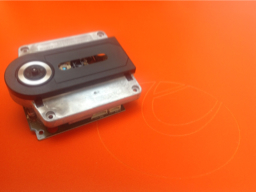
The heart is the well appreciated Philips VAU1255/21LF (CDproM LF) drive, ensuring secure playback of discs. It is clocked either by its own clock (industrial quality) or by a separate low jitter Tentlabs XO3.2 clock (high end audio quality). In case you like to use an external clock order the drive with the clock upgrade:
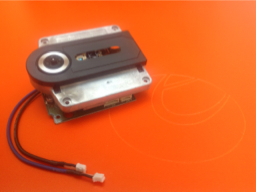
The externally clocked drive needs either:
- Tentlabs XO2.2 module if an integrated CD player is build
- Tentlabs XO3.2 module with reclocked SPDIF output in case a CD transport with external DAC is build
Both drives put out its' data using the I2S digital interface format, which intrinsically is independant to jitter as well as SPDIF. In case the xO3.2 clock module is used, the SPDIF signal is reclocked by that same low jitter clock in order to generate a very low jitter digital datastream for your DAC.
Display / controller
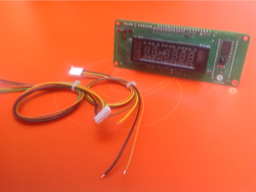
This modules provides communication between the user and the CDpro. A VFD display shows all relevant disc information. While the button Interface translates most normal functions to the drive, an Infra Red (RC5) remote interface provides virtually all commands.
Power supplies
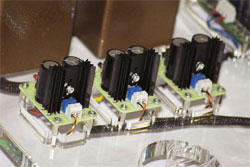
The drive is fed by 2 external Tentlabs power supplies, a third one supplies the controller & display. These power supplies incorporate Schottky Barier diodes, low ESR capacitors and a low drop discrete design regulator. The 9V regulator inhibits a fast switch-off option to ensure proper shutdown of the CDpro drive. This is an absolute requirement otherwise the drive will become damaged. The power supplies can be fed with a 2x9V / 15VA (toroidal) transformer.
Wiring
All required wiring is available as completed and tested assemblies.
Orders
Go to our shop:• CDpro VAU1255/21LF drive
• CDpro VAU1255/21LF drive clock modified
• CDpro power cable
• I2S interface (CDpro - DAC)
• XO2.2 low jitter clock
• XO3.2 low jitter clock
• Controller & display module
• Display power cable
• DSA interface cable (CDpro - Display)
• 5V power supply
• 9V power supply
Download area
• CDpro User manual
• CDpro 2M datasheet
• CDpro Application Note
• CDpro center hub removal
A very nice enclosure on Ebay
• Aluminium, 430x80x330